


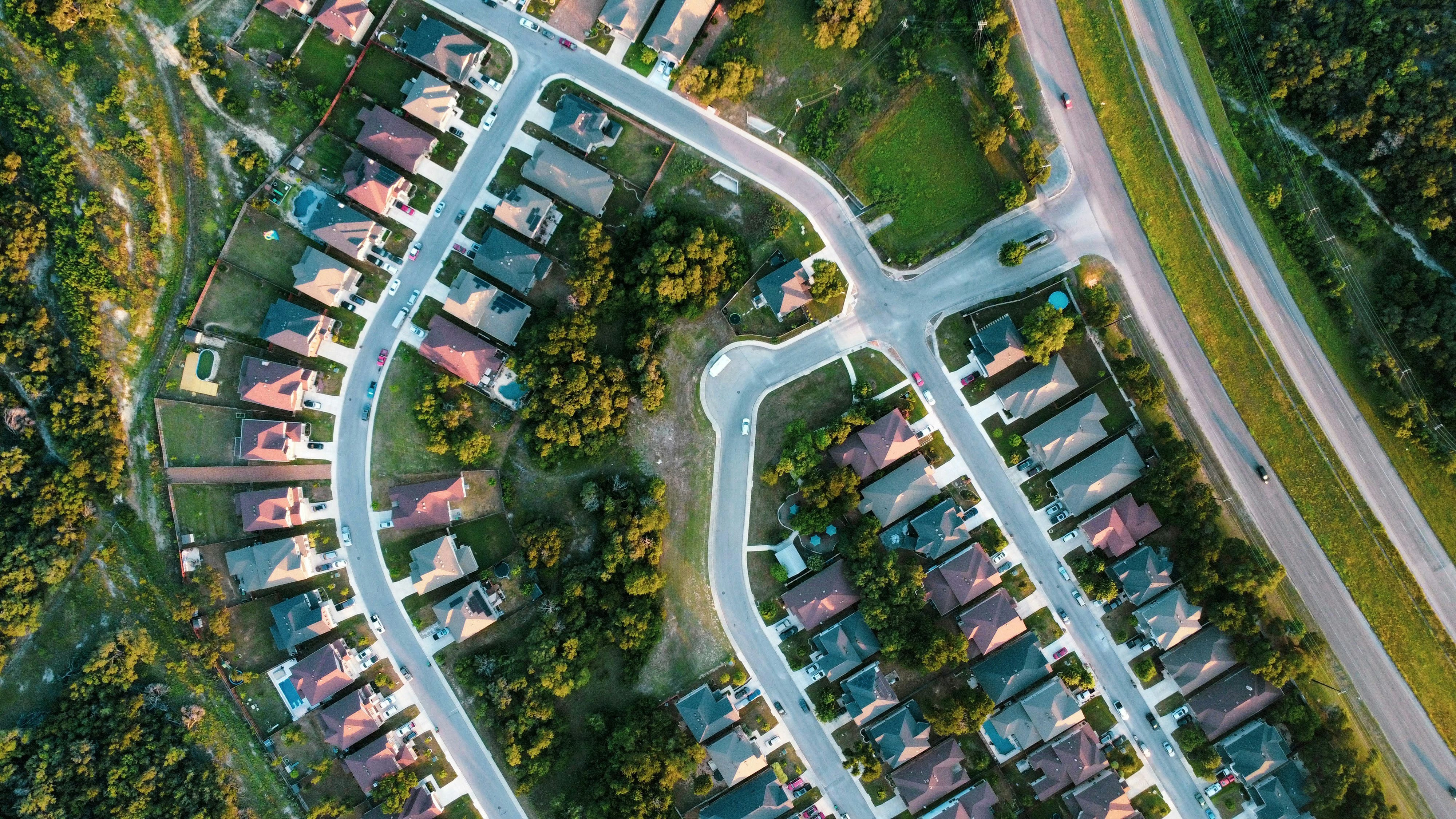
In the last few years, we as a family have tried to be a lot more intentional in finding time visiting our friends and relatives in various parts of the country. This has included a lot of driving through various cities and the countryside across the coasts and the Midwest. A drive likely familiar to most of you reading this. On any of these drives, when you pay attention, you realize that even in an unfamiliar town, there is a familiar pattern. The pattern buried in the landscape of American life that we’ve learned not to see. Drive through any metro area and you’ll pass the same repeating sequence: subdivisions separated from strip malls, office parks miles from residential areas, and the mandatory car trip connecting it all. We’ve built this pattern so consistently across the country that it’s become invisible - the water we swim in, the only way we know how to organize space.
But what if this pattern isn’t neutral? What if the physical design of our communities is systematically generating the crises we’re now scrambling to solve? Crises of climate change, economic inequality, and loneliness epidemic.
The Hidden Costs of Sprawl
Suburban development accounts for approximately 50 percent of all household greenhouse gas emissions in the United States, despite housing less than half the population. The average carbon footprint of households in distant suburbs reaches up to twice the national average, while dense urban cores sit at about 50 percent below average. UC Berkeley researchers describe metropolitan areas as resembling “carbon footprint hurricanes, with dark green, low-carbon urban cores surrounded by red, high-carbon suburbs.”1
In metropolitan regions, suburbs can emit up to four times the household emissions of their urban cores. In the New York metro area, Manhattan households average less than 38 tons of emissions annually, while exurban counties like Sussex County, New Jersey exceed 66 tons per household. It makes you wonder if it is a question of individual choices or if it is baked into the design regardless of individual preferences.2
The Geography of Inequality
The same spatial pattern that drives climate impacts also amplifies economic segregation. Since 1970, residential segregation by income has steadily increased, with the share of families living in either affluent or poor neighborhoods doubling from 15 percent to over 30 percent by 2007.
Suburban sprawl has grown so rapidly that it came at the expense of central cities and older suburbs, with virtually all metropolitan areas seeing suburban rings grow much faster than needed to accommodate population growth. The result? Poor neighborhoods were stripped of basic economic and social assets, while inequality reinforced socio-economic and racial segregation.3
During the heyday of suburbanization, the benefits of suburban life were largely reserved for white Americans, with Black residents systematically excluded through individual and institutional discrimination in real estate and banking, along with racially biased federal policies. While patterns have evolved, research shows that in metropolitan areas that are more compact, children born into the lowest fifth of the income distribution are significantly more likely to reach the top fifth as adults.4
The Loneliness Built Into Our Streets
Perhaps most striking is the connection between how we build and how we feel. Sociologist Ray Oldenburg coined the term “third places” in 1989 to describe the regular, voluntary, informal, and happily anticipated gatherings of individuals beyond the realms of home and work - the cafes, libraries, parks, and corner bars where community naturally forms.
These spaces are vanishing. In a 2024 survey, an astonishing 17% of Americans said they have zero friends, up from just 1% in 1990. The U.S. Surgeon General has declared loneliness an epidemic5, with Generation Z (ages 18-22) identified as the loneliest generation, with 79 percent reporting feelings of loneliness.6
The suburbs are a capitalist brainchild pushing competition and individualism, locking modern Americans in a labyrinth of McMansions and minivans. It matters how we build cities, neighborhoods and places. As effects of these decades-long trends become more clear, discourse on third spaces has recently entered social media. Ironically, as we lose them in reality and replacing it with a fourth space - the digital world.
The Common Thread
Climate crisis. Economic segregation. Epidemic loneliness. These seem like separate problems requiring separate solutions. But they share a common cause: the post-World War II decision to organize American life around car-dependent, low-density, segregated land use patterns.
The United States is the leading emitter of greenhouse gases among developed countries, in part because it is the only developed country with more of its population in suburbs than in cities. The sprawling, automobile-oriented business-as-usual suburb is not sustainable in the era of climate change and fraying social fabric.
To be sure, I am not arguing that suburbs are inherently bad - plenty of suburban residents report similar rates of friendship and connection as urban dwellers. The question is whether the form of suburban development we’ve defaulted to is serving us well. Oldenburg was primarily concerned by the disappearance of third places as suburbanization continues, noting that modern suburbs only offer first and second places with a mandatory car-centric commute between them.
What’s Next: Building COMMONS
If we are to solve challenges described above through an urban development lens, we have to start by identifying and publicly discussing what is working and what isn’t. Ideally, at the grassroots level, and as a discussion recognizing that the way we’ve been building - isolated residential pods connected by highways to segregated commercial zones - has measurable consequences for our planet, our equity, and our well-being. There have been many meaningful attempts - from New Urbanism to pocket neighborhoods - with varying rates of success to change course over the last few decades.
Starting this week, Simeon Talley, Derick Schroeder and I will be publishing a weekly series exploring what community-centered real estate development actually looks like in practice. We will share case-studies of success and failures, conversations with leading changemakers, and most importantly uncover mechanics to solve seemingly intractable problems in urban development.
What to expect:
Expect many threads and many conversations but one shared conviction: real estate development can be, and must be, a vehicle for building stronger, more connected, more equitable communities. We’ll be digging into the practical realities of development that puts community first. Deep dives on specific challenges - how do you actually finance mixed-use development in secondary markets? What does inclusive zoning look like when you’re working with real budgets and real neighbors? How do you create third places that are economically sustainable?
Some weeks we’ll zoom in on tactical questions - the nitty-gritty of capital stacks, zoning variances, and community engagement processes. Other weeks we’ll zoom out to examine broader patterns in how American cities are evolving and what it means for the future of community.
The Good News
This automobile centric urban development pattern is relatively recent. But across the country, developers, planners, community organizers, and residents are testing new approaches. They’re retrofitting dead malls into mixed-use neighborhoods. They’re fighting for zoning changes that allow corner stores and backyard cottages. They’re proving that you can make the numbers work while building community.
We are excited to get started on this series exploring innovative approaches on building better cities and share what we find. Join us.
And if you’re working on a development project that puts community first — or want to explore what that could look like — we’d love to hear from you. Reach out to us at astracommons.com/contact to start a conversation.
Mobin Khan is Founder and CEO of Astra Commons LLC, a community-centered real estate development company. He’s developing projects across midwestern US that put community connection at the center of the built environment.
Simeon Talley is a Midwest-based real estate developer and community builder working at the intersection of arts, culture, and commerce. His work centers on helping emerging projects gain early traction and supporting communities that are frequently overlooked or undervalued.
Derick Schroeder is a licensed Realtor in Iowa focusing on residential real estate and investment properties. When he is not immersed in the world of Real Estate, he enjoys golfing, staying active through exercise, coaching, and cheering for his favorite teams, especially the Hawkeyes..
Together, we’re exploring what it takes to build places worth belonging to.
What patterns do you see in your own community? Where are the third places that bring people together - or where have they disappeared? Let us know in the comments.
References:
1. Spatial Distribution of U.S. Household Carbon Footprints Reveals Suburbanization Undermines Greenhouse Gas Benefits of Urban Population Density, Christopher Jones and Daniel M. Kammen, Environmental Science & Technology 2014 48 (2), 895-902
2. It’s not just cities—suburbs and exurbs need to adopt and implement climate plans too, Megumi Tamura and Joseph W. Kane, April 26, 2023, Brookings Institute
3. The Continuing Increase in Income Segregation, 2007-2012, Reardon, S.F., & Bischoff K. (2016).
4. “Does urban sprawl hold down upward mobility?” Landscape and Urban Planning, 148, 80-88. Ewing, R., Hamidi, S., Grace, J.B., & Wei, Y.D. (2016).
5. Our Epidemic of Loneliness and Isolation - The U.S. Surgeon General’s Advisory on the Healing Effects of Social Connection and Community, 2023
6. https://news.gallup.com/poll/690788/younger-men-among-loneliest-west.aspx
